Business owners naturally want to minimize taxes. Nothing wrong with that. But when you're eventually planning to sell, minimizing taxable income and maximizing business value work in different directions.
Let's say your business spent an additional $200,000 a year for the last three years. For instance, you launched a new product line that didn't produce the revenue you expected and eventually closed it. You invested heavily in a new marketing initiative, didn't get the return, and discontinued it. Or you had expenses running through the business that were not necessary for the ongoing operation of the business.
Assuming a 35% tax rate, those expenses reduced your taxes by approximately $210,000 over three years.
Now you decide to sell. Those expenses won't continue under new ownership, so you want to add the $200,000 back to earnings. That may be a perfectly reasonable adjustment, but now comes the important question: Can we justify it?
If those costs are scattered across payroll, marketing, professional fees and other categories in your P&L, reconstructing them two or three years later can be surprisingly difficult. Buyers and lenders aren't going to give you credit for $200,000 in additional annual earnings simply because you explain that those expenses won't recur.
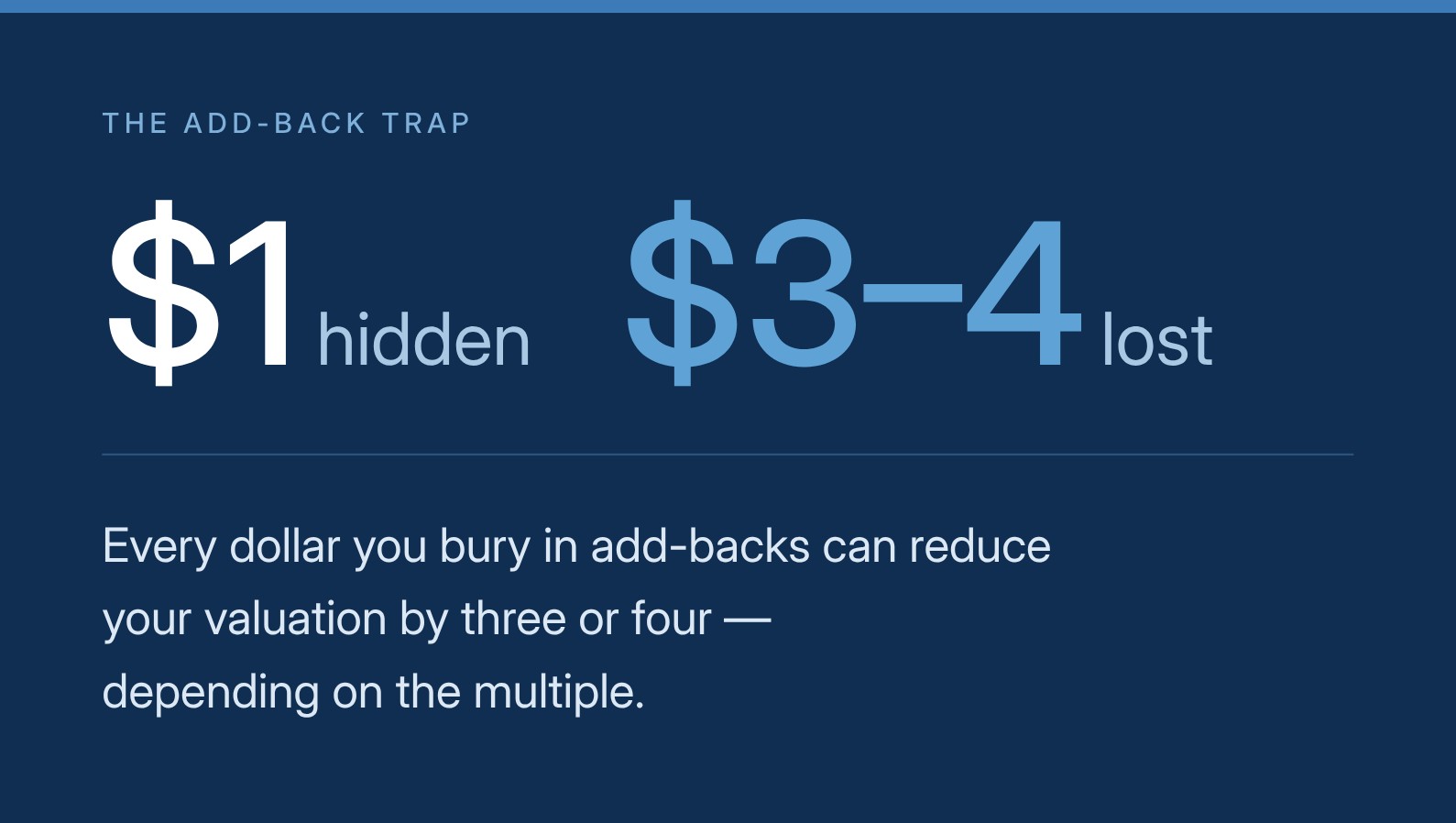
And that's where the math gets painful. If we cannot sufficiently justify the $200,000 add-back and the business is valued at a 3.5x multiple, that's potentially $700,000 in business value that isn't recognized.
You saved $210,000 in taxes over three years, but you may have lost $700,000 at the sale.
The lesson isn't to spend less or pay more taxes. It's to document these expenses clearly and earmark them in your P&L while you're incurring them. If you're testing a new product, opening a new division, or making a significant investment outside normal operations, make sure those costs can be clearly identified years later.
This is part of what we Business Brokers do for our clients when we get to them early enough. We educate owners about how decisions they're making today may affect valuation later, and what they should document now so we have the evidence to make the strongest possible case when it's time to sell.
Because when we get to valuation, “I can explain that” and “I can justify that” are two very different things.
What are businesses in your industry selling for? Request a complimentary Industry Multiples Insight.