Most owners overestimate what their business is worth. Not because they’re irrational — but because they’re using the wrong scoreboard.
They confuse effort with value.
They confuse revenue with earnings.
They confuse potential with proof.
And they assume the market will “see what I see.”
It won’t.
A buyer doesn’t pay you for pride, sacrifice, or years of work. A buyer pays for a defensible story about cash flow and risk — and they will dismantle anything that isn’t supported.
1) Your valuation isn’t a number. It’s a justification.
Owners often say: “Businesses in my industry sell for X multiple.”
That’s not a valuation. That’s trivia.
Valuation is a claim you make — and then defend — using:
- normalized earnings (what the business really generates)
- transferability (can it run without you?)
- concentration risk (customers, vendors, people)
- quality of financial reporting (can your numbers survive diligence?)
- and the terms required to get the deal done
The multiple isn’t the starting point. It’s the result of how credible your justification is.
2) “But look at our potential” is usually a discount, not a premium.
Sellers love upside narratives:
- “A buyer could scale this fast.”
- “We’ve never marketed.”
- “If someone hired salespeople, revenue would explode.”
That’s not value. That’s homework.
Future potential only helps when it is already evidenced by:
- repeatable lead flow
- signed contracts / pipeline with conversion history
- documented unit economics and capacity
- systems and people that can execute without heroics
Otherwise, it’s execution risk — and risk gets priced against you.
3) Your business might be profitable… and still be worth less than you think.
Here are the quiet killers of value that owners underestimate:
- Owner dependency: Are you the sales engine, the relationship holder, the problem solver, the decision bottleneck? Buyers will haircut earnings or demand earnouts.
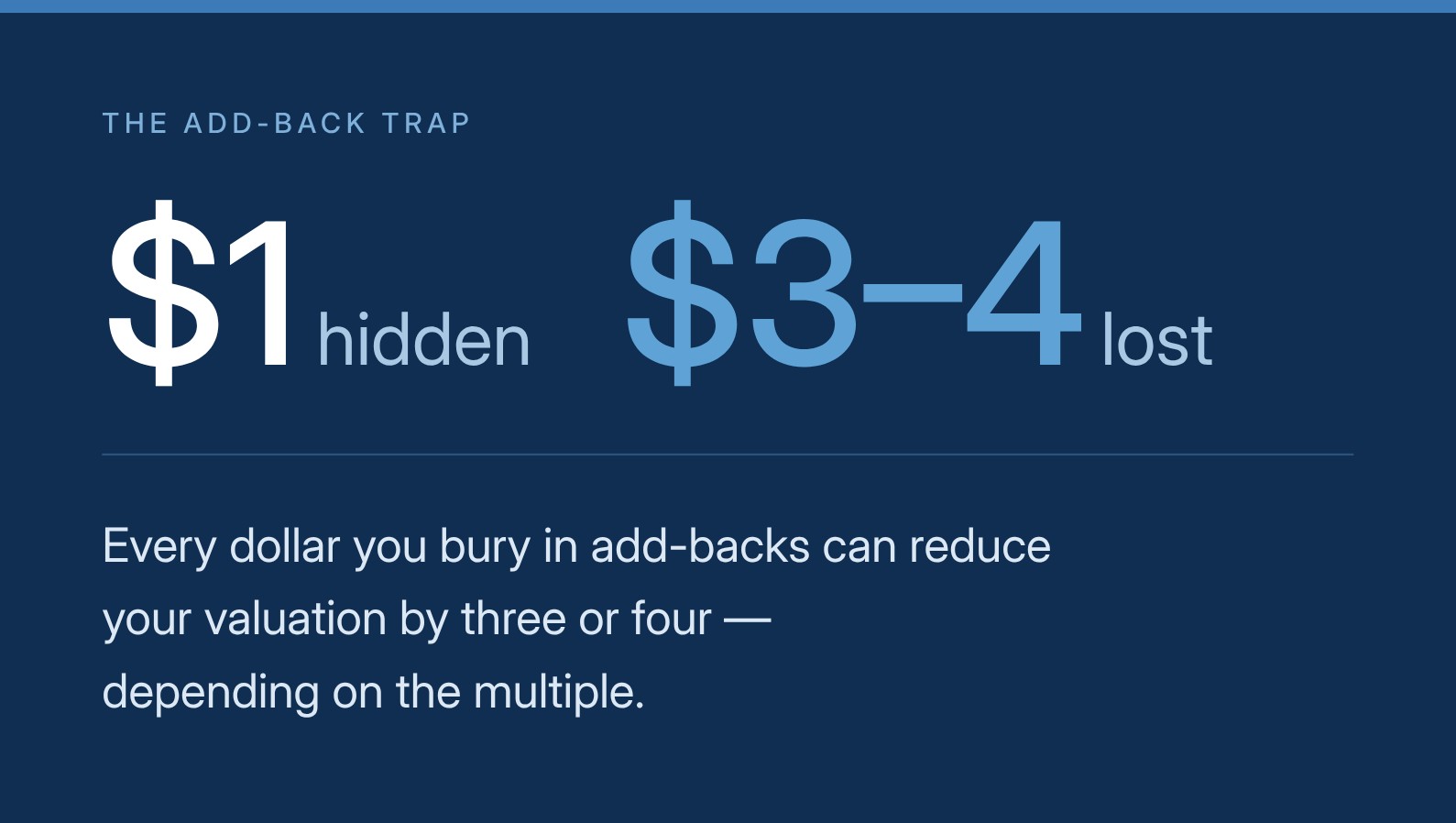
- Messy add-backs: “Personal expenses” and “one-time costs” that aren’t clean, consistent, and well-documented get ignored or discounted.
- Customer concentration: One customer at 25–40% of revenue doesn’t just lower value — it can change deal structure entirely.
- Weak reporting: If monthly financials are slow, inconsistent, or “we’ll fix it later,” buyers assume there’s more you’re not showing.
Profit doesn’t automatically equal a premium valuation. Profit with weak defensibility equals leverage — for the buyer.
4) The market doesn’t reward effort. It rewards optionality.
Owners think: “I built something special, buyers should recognize it.”
Buyers think: “How easily can I own this, operate this, and protect my downside?”
That’s why two businesses with the same revenue can have wildly different outcomes. One has:
- clean earnings
- a transferable operation
- low concentration risk
- and a coherent story
The other has anecdotes.
What to do with this
If you want a strong outcome, stop asking, “What do I think it’s worth?”
Ask: “What would an intelligent buyer challenge and how do I justify through it?”
That’s how you move from wishful valuation to defensible valuation — and from “maybe we can sell” to a real process with real leverage.
What are businesses in your industry selling for? Request a complimentary Industry Multiples Insight.